


The adage “Life is short” feels inaccurate. A monk might say that when lived fully in the present moment, your life can feel luxuriously long.
Here’s the real stuff of terror: the people we love — however complicatedly — can float away anytime, at some unknown moment.
We humans are cute. Our productivity often wins out over wisdom. We run around making painstaking plans, but the truth is nobody is guaranteed the next Thanksgiving, Monday morning, or even the next hour. This fact rings louder in my head the more my parents’ hair turns silver.
Before retiring, my dad was a painting contractor. His “business suit” was a pair of white Dickies overalls and Timberland boots, splattered like a Jackson Pollock painting.
He and my mom were Korean immigrants living in 1990s Silicon Valley. Long before the heyday of Google Ads, he bought thousands of flyers to “spray and pray”. The folded gray card stock depicted squat, friendly cartoon painters sprucing up a suburban house.
As his unpaid junior assistant, I stuck address labels on the flyers and made a “client book” by drawing lines in a spiral notebook from Target. Dad insisted I use a 0.7mm black ballpoint pen and ruler for this. My baby sister’s handsy curiosity often made my straight lines run jagged.
Sometimes Dad would drag me to Home Depot for supply shopping — the most boring place on earth for a preteen girl. I’d begrudgingly play a poor substitute for the son he didn’t have. On lucky days, we’d exit through the Garden Center.
I adored the book The Secret Garden by Frances Hodgson Burnett, and the Eastside San Jose Home Depot Garden Center was the closest I could get to being enveloped in a floral oasis. Row after row of their signature orange metal shelving held hundreds of waxy green, industrially-grown plants. Sometimes, Dad ignored the plants to look at fertilizer or pebbles for interminable minutes.
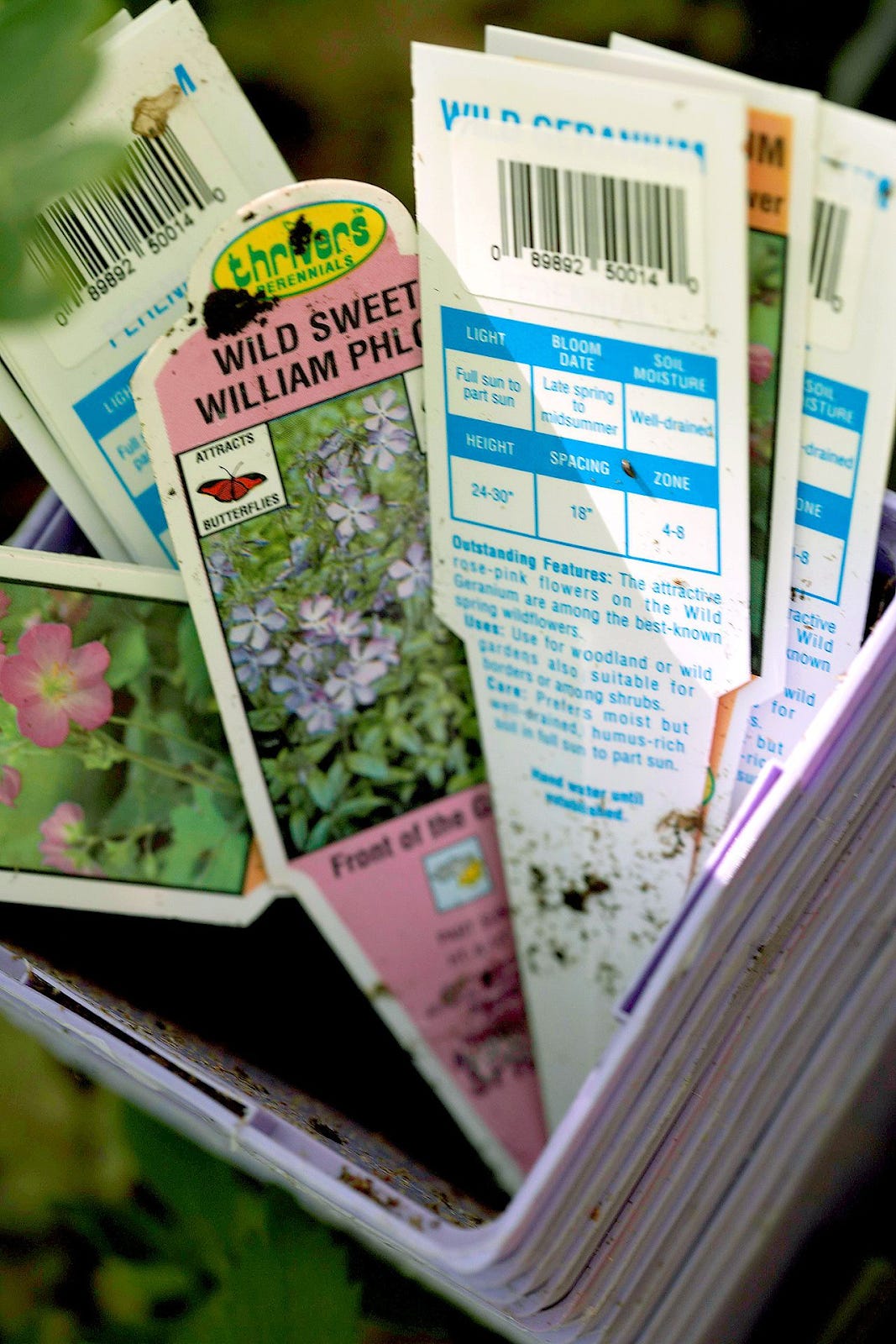
So I busied myself reading plant care cards. I skipped up and down the aisles, giving the shiny plastic a gentle flick before reading “do’s and don’ts” for peace lilies, pothos, bromeliad, and azaleas.
Plant care cards are humble heroes. Every plant comes with this small but mighty piece of graphic design. They peek out the dirt, containing the secret to life thriving or withering. There’s comfort in their clarity: here’s what you do. Don’t do this, though. Meet its needs as instructed and you’ll be rewarded.
Most evenings, Dad buried his head in a newspaper and cradled a Jim Beam on the rocks. Mom barely sat down, too busy fetching the side dishes he wanted — or water, which he was inches away from! — every few minutes. My sister and I teetered between giggling or quarreling, depending on our moods.
I’d look across the table at this man. There he was, and yet he felt so far away. I could read about the needs of flora, but hadn’t a clue about my own father’s.
Between Dad and me, the past holds a barren field of lonely silences and missed opportunities to connect. Who are the people we call our loved ones?
I really wish I had a plant care card for my dad.
If we’d exchanged person care cards, I could have seen my dad as a whole person, someone who is growing and needs care.
Instead of being grumpy on car camping trips, I could have appreciated him wanting to share his love of nature with us.
I could have realized he wasn’t ignoring us — he was in deep study of current events, reading between the lines to form his own opinion.
I could have had compassion for him stomping around the house and speaking loudly. He’d served years in the military, and his hearing was already starting to fade from the gunfire exposure.
He might have seen me more clearly too. More than a silly girl tying up the landline. Maybe as someone who needed certain light, water, and soil conditions to thrive.
Instead of getting impatient and frustrated with me, he might have appreciated that I was working well above my pay grade, trying to help him and my mom to understand bills, legal policies, and opaque social interactions.
He might have had compassion for my mistakes. I was straining to figure out how to be a good daughter and older sister by his standards, which felt at odds with discovering who the hell I actually was.
My sister has a positive affirmation app on her phone. It sits on her home screen, a black rectangle with elegant white serif font. Her message the other day was
“Instead of holding on to what I could have done, I am taking action to do what I can, now.”
My dad and I speak English and Korean to each other, yet don’t understand. I wish he came with instructions. But people don’t. Sometimes we have to write it for them. And then I realize he does have a Person Care Card. It floats around in the substrate of my heart and mind.
Thanks to the unearned luck that keeps graces me, he’s alive and well. I can pick up the phone and hear his voice.
He’s happy when I do, though it rarely seems that way because he’s absorbed in his latest YouTube intrigue, like an explainer on what stocks even are, or a nature doc on the alien-on-earth Japanese spider crab.
There is a recurring blue task reminder on my calendar to call him. Because the act is a push, not a pull. I can’t wait for the pull, to feel inspired; that’ll arise in the endless expanse of grief somewhere ahead, when he’s gone. So I push, make a fumbly call.
It’s awkward and unsatisfying. But in this area of my life, quality of content doesn’t matter at all. The mere act of showing up and being kind is enough. With each conversation, we grow and heal (are they the same?). It’s happening at a glacial pace, but that’s okay. The speed doesn’t matter either.
Very grateful to Vincent Tam, Camilo Moreno-Salamanca, Robby Montoya, Garima Mamgain, Gordon Tang, Matt Joass, and Karaminder, Sandra Yvonne, and Danielle for your feedback, comments and encouragement.
The credited images were made by humans who got paid for their work.
I love (and relate) to this so much. When my dad was dying last year, I told him my favorite memory of him. When I was in elementary school, I had to make a robot for a school project (not a real robot, just one out of cardboard). He was all too excited to fetch me nuts, bolts, and washers from his toolbox treasure trove in the garage to make the robot look realistic. I remember having such a bad attitude about him helping me in this way, and being really difficult. It wasn't until I got older that I realized it was because I wanted my robot to look pretty and, in my mind, using these materials made it the complete opposite. I was too young to know that's what I was feeling, much less communicate it. I feel like so many of the (dumb) friction points we had were because we didn't know how to communicate with each other (maybe me moreso than him). But realizing that gave me a lot of perspective, and even turned it into one of my favorite memories of him.
Hi Kat, I really enjoyed reading your piece. It made me think about the lines of communication between different generations. My mom is hella traditional and we get lost in communication. She has her own ideas of the world. As I have mine. I have to remind myself that love and care is at the basis of our relationship even if it's shown in a a different way. I love your line about moving at a glacier pace because any change is some type of movement.